What’s the Next Big Move for the D4 RIN?
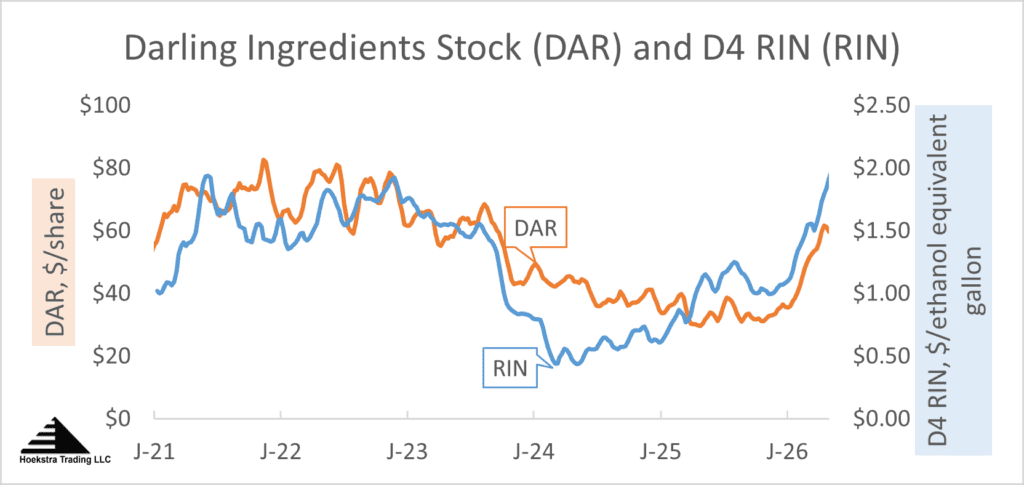
Darling Ingredients is one of many biofuels companies whose stock price correlates with the price of the D4 Renewable Identification Number (RIN) environmental credit as shown on this 5-year chart.
The D4 RIN is a complex credit. It is a tax, a subsidy, a mandate, an asset that can be bought, sold, banked, borrowed, and traded. As a financial instrument, the RIN is an option that comes in 3 different expiration dates. And those options are the underlying instruments for exchange-traded futures contracts.
Moreover, the D4 RIN is just one in a family of four equally complex RINs that are intertwined in an oddly nested scheme.
I claim this makes the RIN the most complex financial instrument ever invented– at least among commercial financial products that affect the prices of major global commodities like gasoline, diesel fuel, corn and soybeans.
The economic theory of RIN pricing has been worked out in detail, and that theory has been shown to accurately describe actual market prices when analyzed over periods of several months. For 6 years, Hoekstra Trading has focused on making that theory available in user-friendly forms that are readily digestible to anyone seriously interested in the topic, for use in assessing opportunities and risks related to RIN prices.
What risks are faced by biofuels companies today? That question was asked of panelists at a biofuels conference last week, and a good list of risks came out. But absent from the list was the risk the D4 RIN price has gotten ahead of itself. In fact, that risk doesn’t seem to be on anyone’s risk list today.
What will be the next big move in the D4 RIN? If history is a guide, when it happens, it will surprise the C-suites of even the largest biofuel players.
Hoekstra Trading offers fundamental RIN price theory in the digestible form needed for real life use to help biofuels companies assess RIN-related risks.
Contact george.hoekstra@hoekstratrading.com 630 330-8159.
On April 20, 2026, Hoekstra Trading released the 2nd quarterly issue of the “Hoekstra RIN Price Outlook”. Why not have a look under the hood?
