Posts by Hoekstra Trading LLC
RIN Price Outlook — D4 RIN Will Fall
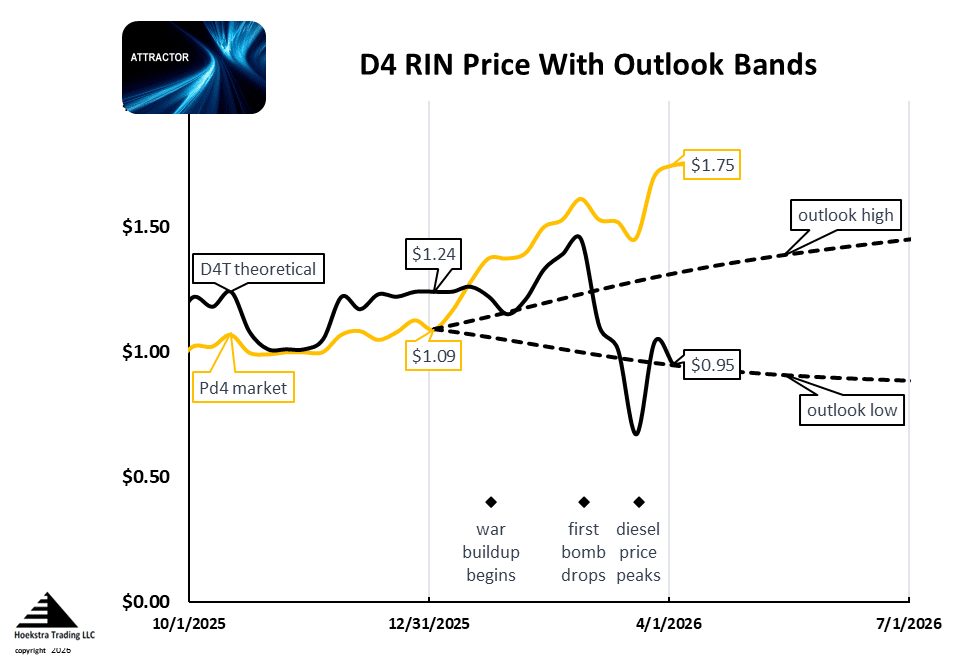
The gold line is the market price of the current vintage D4 Renewable Identification Number (RIN) which went up from $1.09 to $1.75 in the first quarter of 2026. The black line is Hoekstra Trading’s theoretical price (D4T), which fell from $1.24 to $0.95 in the first quarter. The dashed lines show our original 2026…
Read MoreTop 3 Takeaways – Bloomberg Farm, Food and Fuels Summit 2026, Kansas City

Number 3) Confounding Complexity This conference, as the name implies, takes on the complexities of the farm, food, and fuels industries by covering the crude oil, corn oil, and chicken feed businesses, all at one event. Participants can choose among parallel breakout sessions and quickly learn about each industry, with its own deep knowledge base…
Read MoreWhat Happened to the D4 RIN Price?
In the last 2 weeks, Hoekstra’s D4 RIN theoretical price (named D4T) has fallen by 44 cents, from $1.45 to $1.01 per RIN, while the market price of the 2026-vintage D4 RIN fell by 9 cents, from $1.61 to $1.52. In analyzing this difference, the first key point is that the ultra-low sulfur diesel (ULSD)…
Read MoreTop 3 Takeaways from National Ethanol Conference, Orlando Feb. 24-26, 2026
My Top 3 Takeaways: Number 3 — California’s Ethanol Awakening 87-octane E15 gasoline, containing 15% ethanol, is now a legal fuel in California. Expect it to soon become the state’s base fuel, replacing E10 at a 45 cents/gal lower pump price. California has the nation’s highest gasoline prices and a history of driving out petroleum…
Read MoreHoekstra Trading D4 RIN Price Outlook 2026

D4T is Hoekstra Trading’s calculated theoretical value of the D4 RIN. At the start of 2026, D4T was $1.24 per ethanol equivalent gallon (EEG). D4T is compared with Pd4, our name for the market price of a corresponding D4 RIN, which was $1.10/EEG at the start of 2026. The outlook bands in Figure 1 show…
Read MoreA RIN Price Separation Scenario

In coming months, the D4 and D6 Renewable Identification Number (RIN) prices are likely to separate from each other. Several combinations of circumstances could cause this. What might that look like? This chart shows one scenario. In this case, a RIN system boundary is crossed, like when a flowing stream overflows its boundaries. The ATTRACTOR…
Read MoreNew Hoekstra-Bloomberg Licensing Agreement

Hoekstra Trading LLC is pleased to announce the expansion of its Data Acquisition Agreement with Bloomberg Finance LP to now include the licensing of D6T, the theoretical value of the D6 Renewable Identification number (RIN). Under the agreement, Hoekstra will provide weekly D6T values along with the values of D3T (first licensed in 2024) and…
Read MoreWhat Will Cause Separation of the D4, D5 and D6 RIN Prices, Part 5 (final episode) – The ATTRACTOR RIN System Roadmap

See other blogs in this series: What Will Cause Separation of the D4, D5, and D6 RIN Prices? Part 1 of this series shows that Renewable Identification Number (RIN) price movements like the Big Bang are caused by boundaries (like the Blend Wall and the RIN Cliff) that don’t exist in free, uncontrolled markets. Part…
Read MoreWhat Will Cause Separation of the D4, D5, and D6 RIN Prices? Part 4 – The Next Big Move
In the U.S. biofuels market, it has become normal for the prices of three Renewable Identification Number (RIN) credits to be the same. They are the D4 (biomass-based diesel), D5 (advanced biofuel) and D6 (conventional renewable biofuel) RINs. This equality is caused by special circumstances that have applied at times. The current question is what…
Read MoreWhat will cause separation of the D4, D5, and D6 RIN prices? Part 3 – D6 RIN pricing framework

In the U.S. biofuels market, it has become normal for the prices of three Renewable Identification Number (RIN) credits to be the same. They are the D4 (biomass-based diesel), D5 (advanced biofuel) and D6 (conventional renewable biofuel) RINs. This equality is caused by special circumstances that have applied at times. The current question is what…
Read More